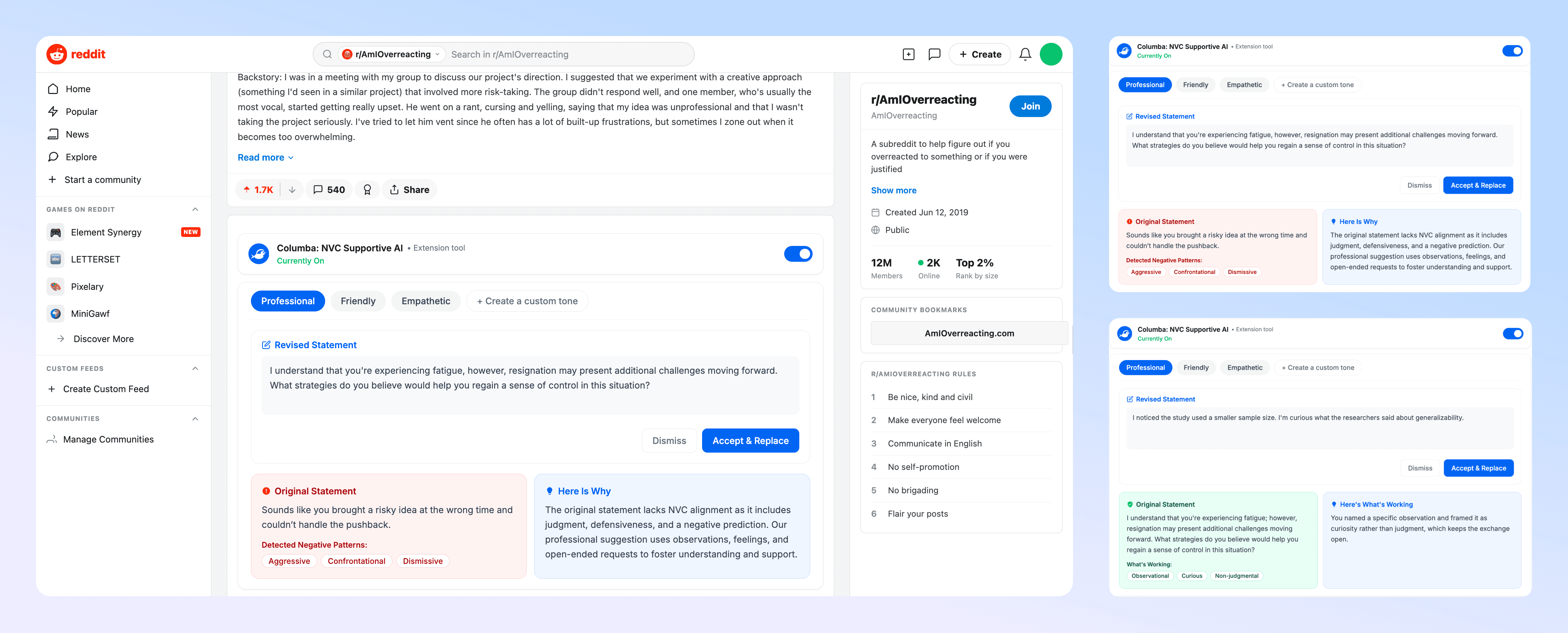
Columba is a Reddit browser extension that uses Nonviolent Communication (NVC) principles to surface a reflective pause before users post in high-friction conversations. I led the end-to-end interaction design, built and maintained the design system, ran cognitive walkthroughs, and defined the KPI framework. The project explores a question most AI writing tools avoid: when should the AI step back instead of step in?
My Contributions
I owned the end-to-end interaction design of the comment intervention flow, built and maintained the design system, ran all cognitive walkthroughs (n=9), and defined the KPI framework within a team of 1 designer, 1 developer, 1 product manager, and 2 researchers.
Product Design Lead
01.2025 - Present
Interaction Design / Design System
AI Research / Cross-Functional Teamwork
Context
Turning NCD Theory into a Real, AI-Driven Tool
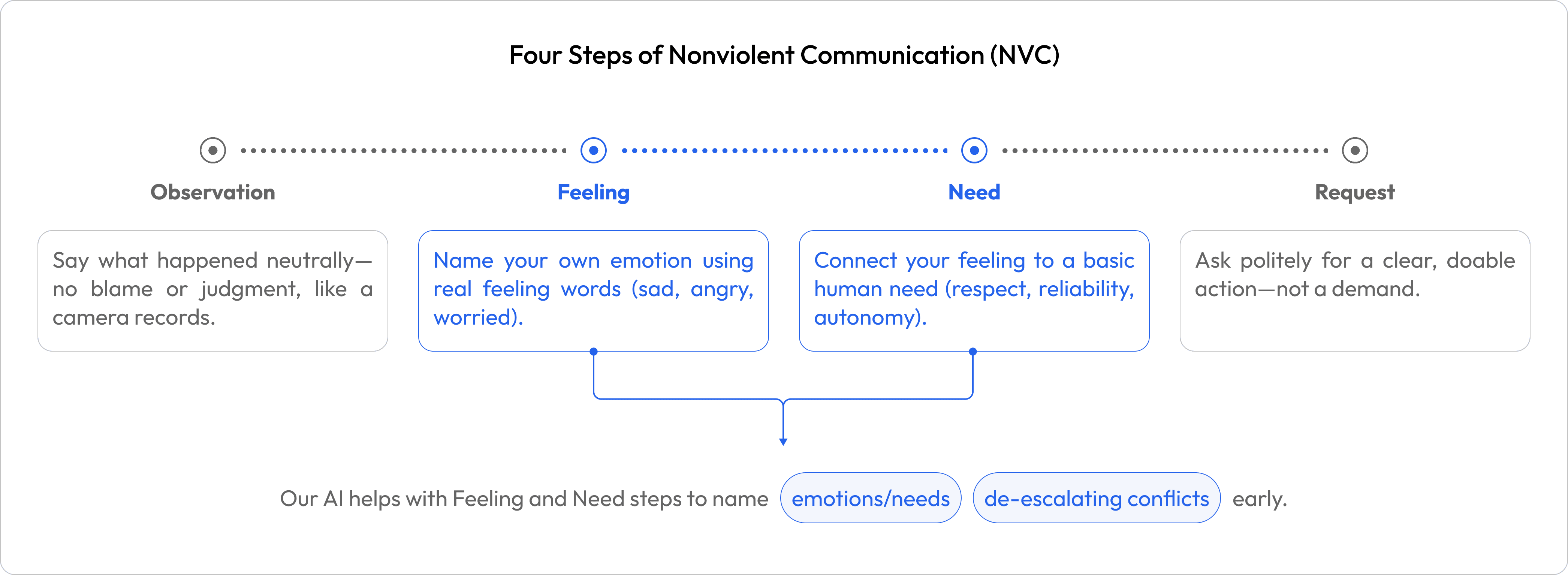
Our system is grounded in Needs-Conscious Design (NCD), a framework that translates NVC’s psychological principles into actionable design goals. We specifically focused on the Observation and Needs stages of NVC to move away from "tone policing" toward a reflective interface. By integrating NCD, the system acts as a facilitator for emotional intelligence, helping users stay intentional and connected in high-friction environments.
Problem
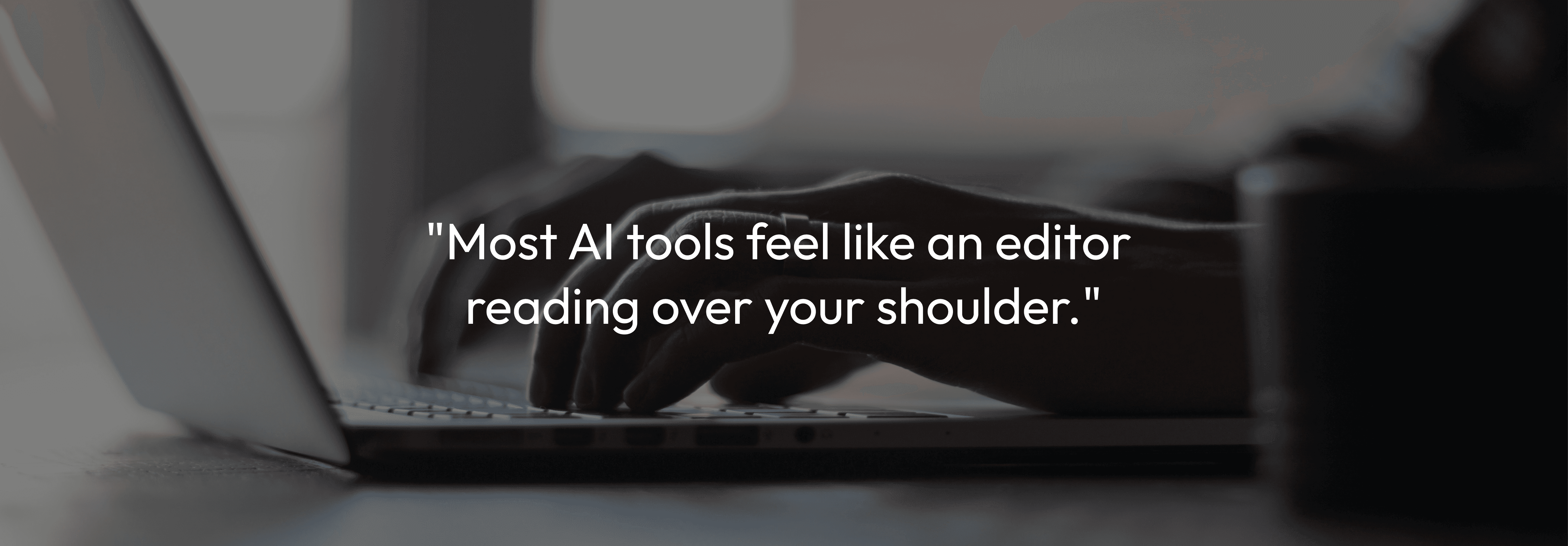
The Tension Between Guidance and Autonomy
Hypothesis Test
Four Hypotheses. Three Confirmed. One Reshaped the Product.
I framed the design problem as four testable claims, then ran interviews and cognitive walkthroughs with 9 participants to validate or reject each one. Three were confirmed, one was refined, and that refinement reshaped the product. H4's findings led directly to the "Here's Why" pattern: short single-sentence explanations instead of full educational content.

Competitive Landscape
Existing AI Tools Optimize for Output. Not for Ownership.
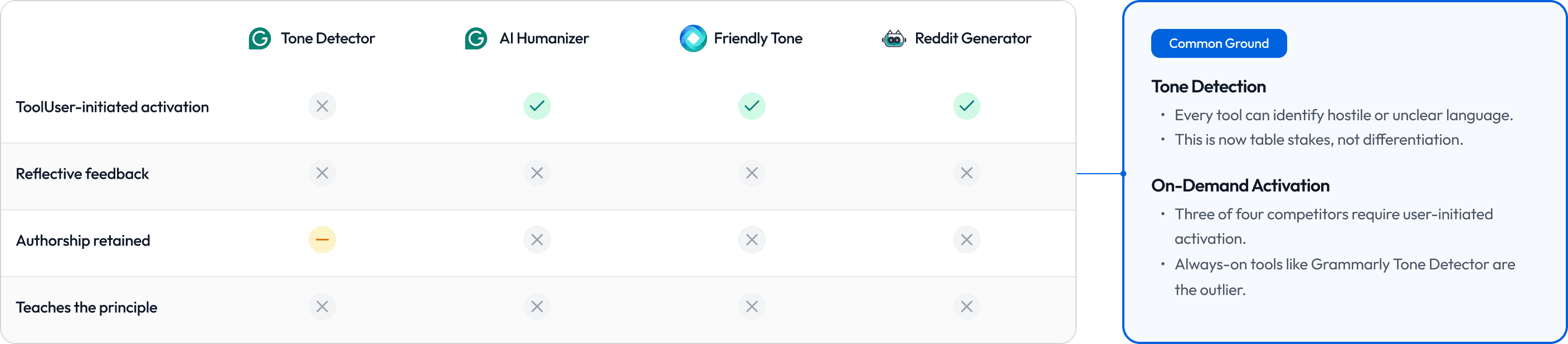
I compared four core capabilities across existing AI writing tools to separate table stakes from real opportunities. Tone detection and on-demand activation were already common, so simply adding them would not differentiate the product. The bigger opportunity was designing for what competitors left unresolved: helping users understand their choices while keeping authorship in their hands.
How I got there
Smarter Assumptions Can Still Be the Wrong Ones.
Hypothesis testing surfaced the principles. Cognitive walkthroughs validated and refined them. The hardest decisions weren't visual. They were about when AI should intervene, what control users actually need, and which "helpful" features quietly undermined the core principle.
Building the Design System Before the Product
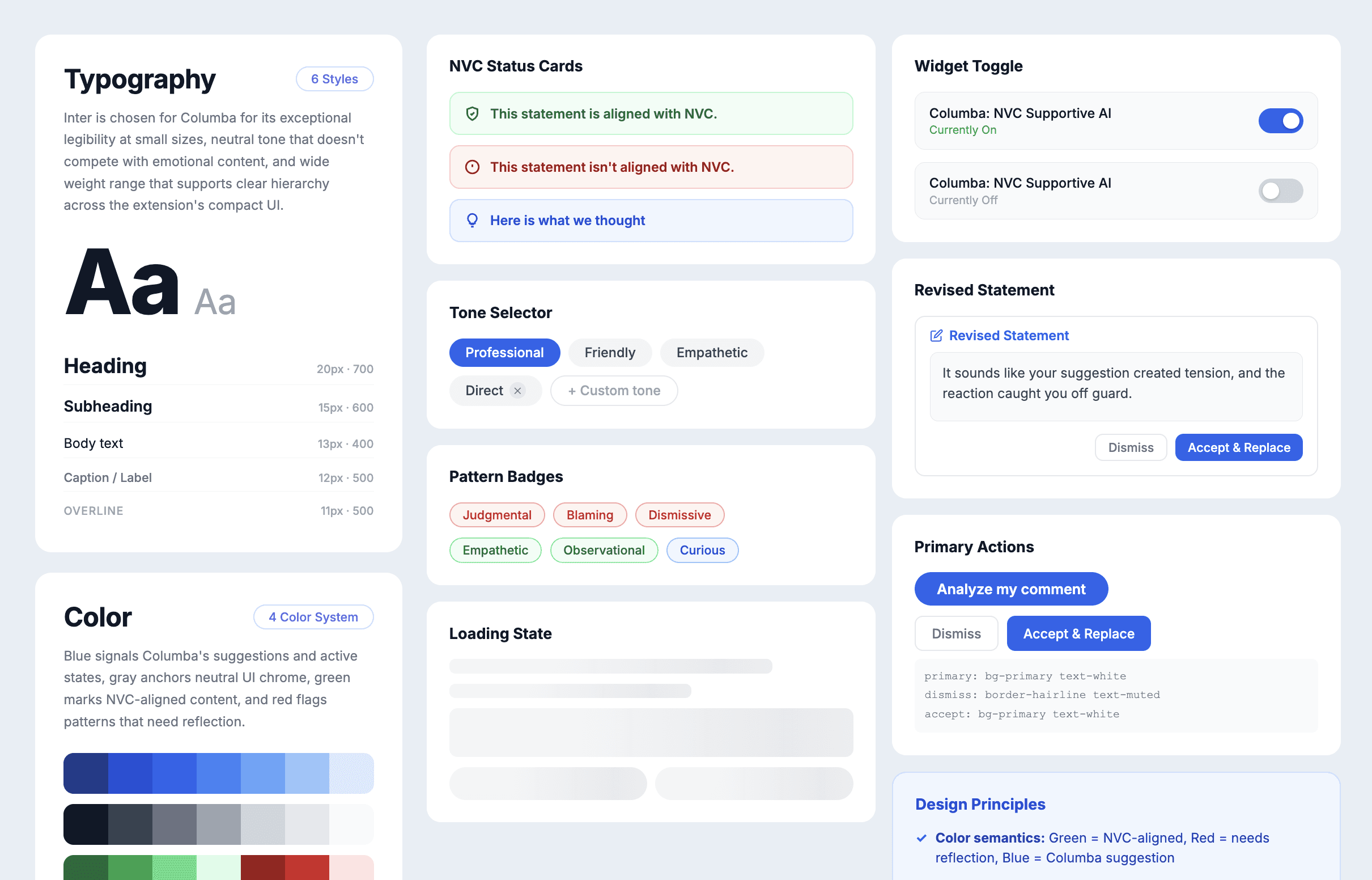
I built the design system alongside the intervention flow so every state could reinforce the same principle: support reflection without taking control. Reusable patterns for analysis, tone choice, explanations, and confirmation made the experience consistent as the product evolved—and gave the team a shared language for designing AI assistance with user agency intact.
Four Iterations to Land One Decision
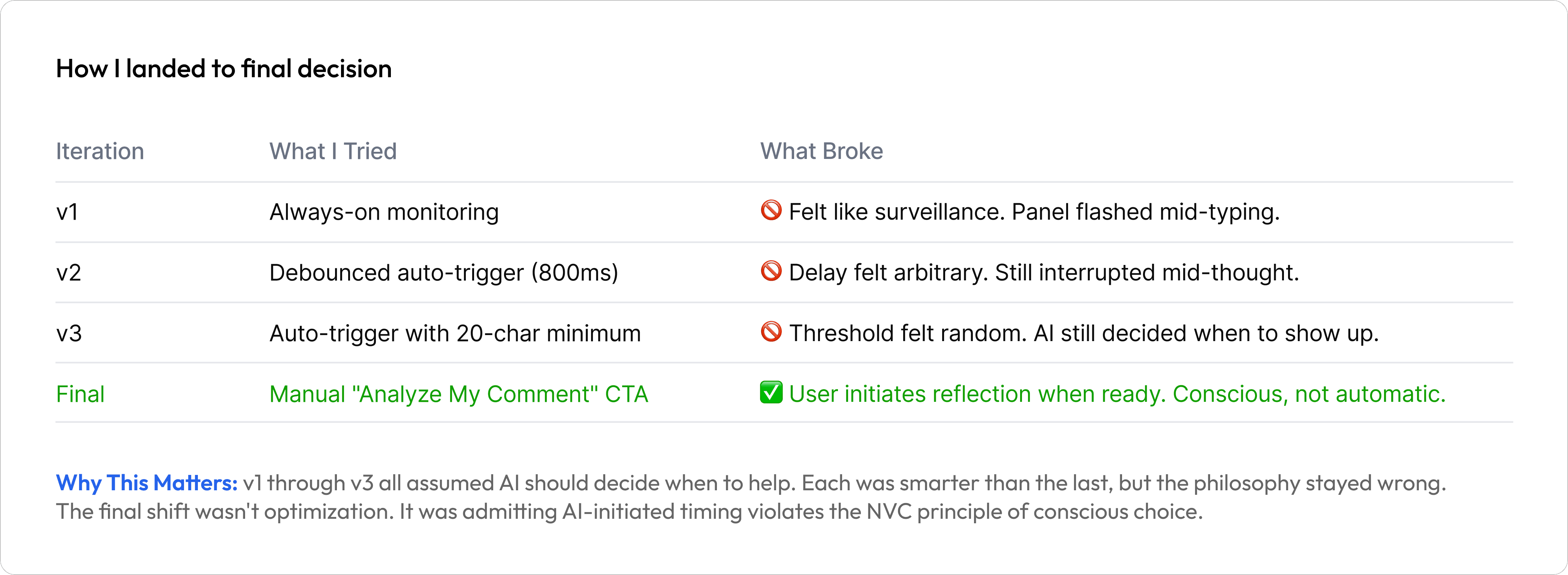
The biggest behavioral question on Columba was when the AI should analyze a comment. I went through four iterations before settling. The shifts weren't visual refinements. They were philosophical course corrections.
What I Killed, and Why
Three features were removed entirely when walkthroughs revealed they undermined the core principle.
Judgmental Color-Coding: Red/yellow/green cues felt like "moderation" to 6 of 9 participants. Shifted users from reflective to defensive mode.
Rigid Tone Presets as Default: Locked categories failed edge cases. Replaced with a single swappable slot.
Regenerate-Only Rewriting. Lowered perceived authorship in testing. Replaced with "Here's Why" so users rewrite in their own words.
Outcomes & Impact
Validating User Control & Intent
Through a controlled pilot study, we validated that Columba supports healthier communication while maintaining high user autonomy.
Rewrite adoption rate: +25% of sessions apply at least one suggestion (useful without forcing).
Tone improvement: In randomized A/B blind tests (n=9), 70% of reviewers favored NVC-informed drafts as more constructive and less hostile.
Time cost: –25s median added time from intervention trigger → final post (keeps friction acceptable).
Perceived Control (%, 5-point): +80% select 4–5 (“Agree/Strongly agree”) for “I felt in control of my final message.”
These metrics demonstrate that Columba functions as a supportive partner rather than a prescriptive editor, balancing automated guidance with human-in-the-loop control.
Reflection
Research to Ethical Product Design
The hardest decision in this project wasn't a visual or technical one. It was figuring out how much the AI should actually do. Every time I made the suggestions more helpful, users felt less like the final message was theirs. I had to keep pulling back, not because the AI couldn't do more, but because doing more was the wrong goal. That tension, between a capable system and a respectful one, defined every major design decision I made.
If I were starting over, I'd push harder to expand beyond n=9 in the pilot study. The directional findings were clear, but a larger sample would have given the statistical confidence to make stronger claims about which specific intervention patterns drove tone improvement versus which ones users simply tolerated. That's the difference between a research finding and a design principle you can actually build on.
What this project permanently changed for me: I used to think about AI design in terms of capability, what the model can do and how to surface it well. Now I think about it in terms of agency, at what point does the AI's helpfulness start eroding the user's sense of ownership? Columba taught me that the best AI interaction is often the one that prompts a person to think, not the one that thinks for them.